Cross-platform delivery
Native mobile audio, browser-based clinician controls and focused client displays support in-person and remote workflows.
 AFFECT FORGEStart a conversation
INVESTOR BRIEF
Affect Forge brings clinician control, client-facing stimulation and sensor-informed research into one cross-platform system.
Product and wearable concept imagery · features in development
THE INVESTMENT THESIS
EMDR already operates within established PTSD care pathways. The opportunity is to improve the tools around delivery: synchronized bilateral cues, simple remote controls, accessible client reporting and carefully bounded physiological context.
Affect Forge begins with software clinicians can use today and develops the evidence, hardware and quality systems required for more advanced capabilities over time.
ONE CONTROL PLANE
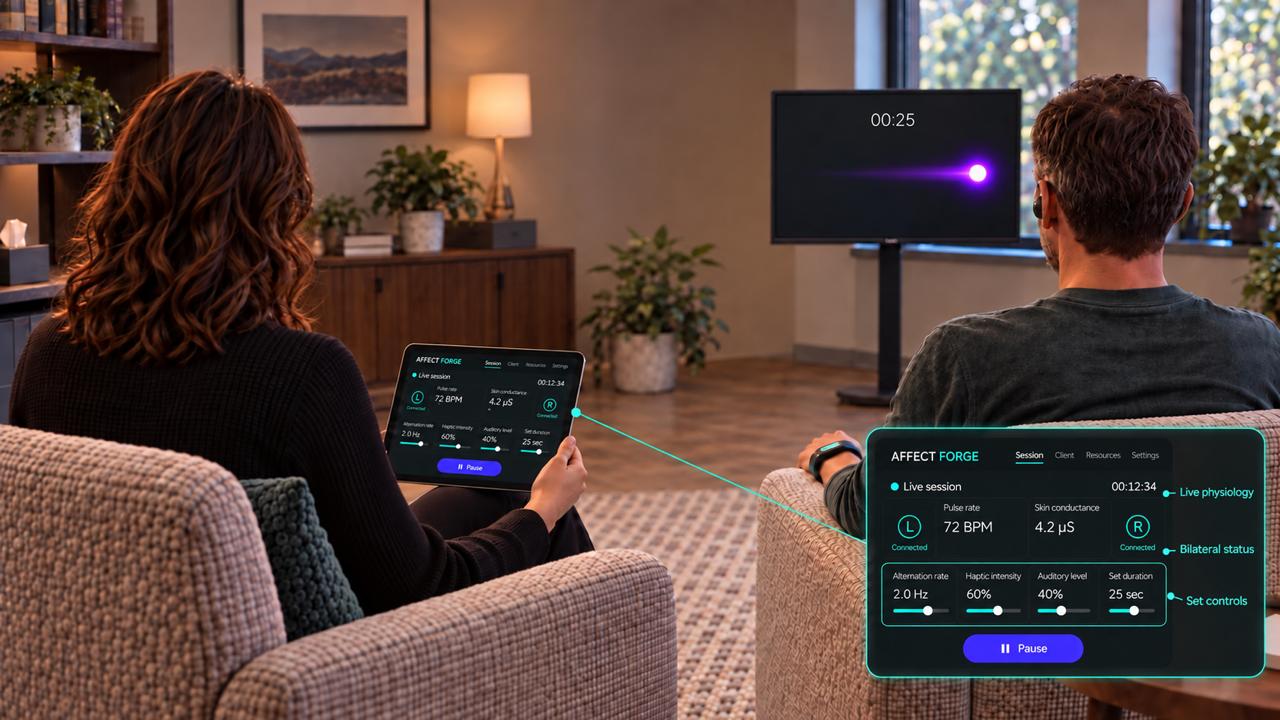
The platform separates the practitioner workspace from a focused client experience, then connects compatible devices through a shared session rhythm.
PLATFORM ADVANTAGE
Native mobile audio, browser-based clinician controls and focused client displays support in-person and remote workflows.
Haptic units and the Duo Ring concept extend the system while keeping the software layer useful on its own.
Accessible reporting formats and physiological trends are treated as questions to validate, not automated clinical conclusions.
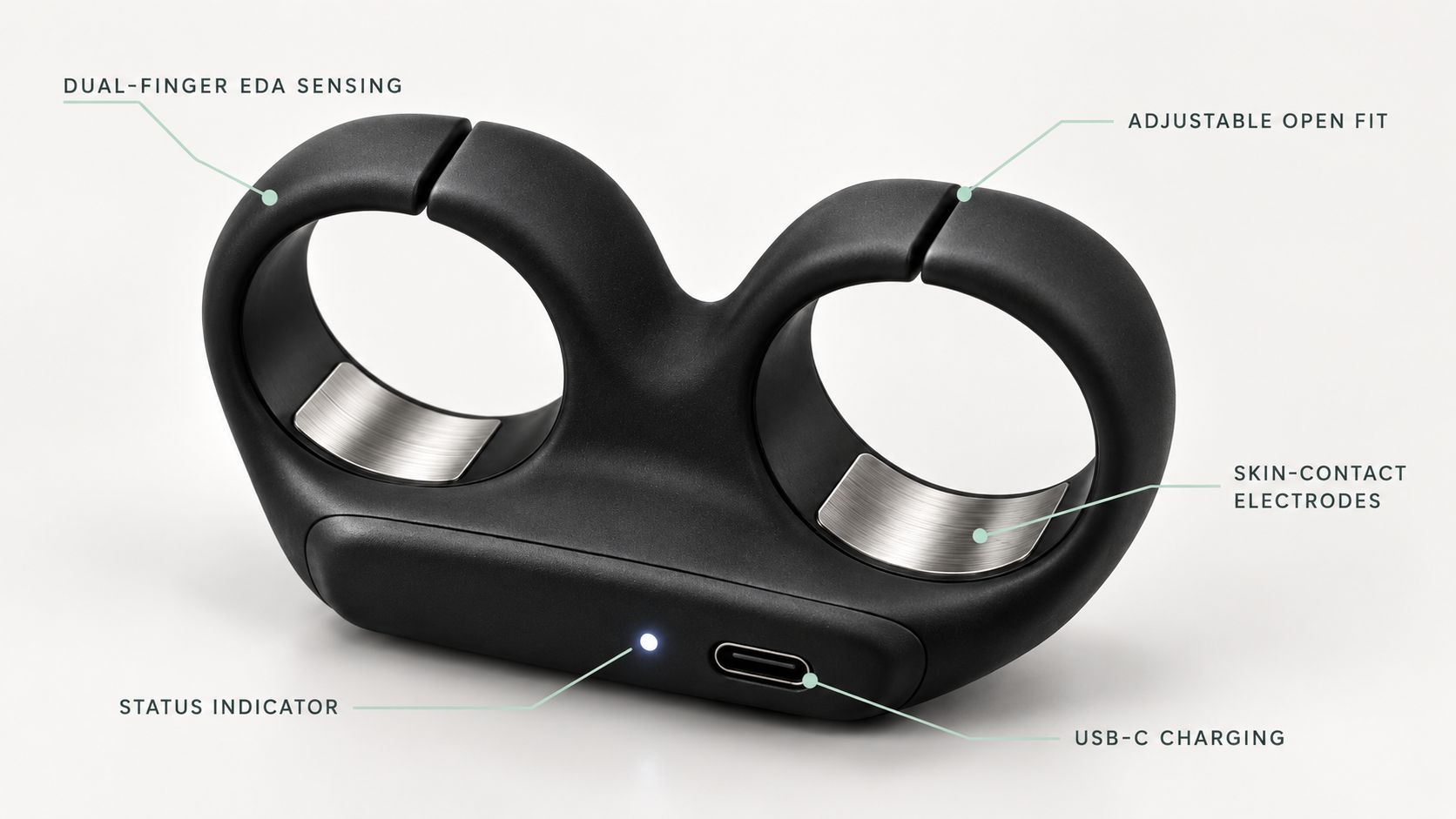 DUO RING CONCEPT · HARDWARE IN DEVELOPMENT
THE CLOSED-LOOP RESEARCH PATH
The proposed sensor layer combines client report, practitioner observation and optional physiological trends. Future gaze-engagement research may add another measurable signal, processed on the client device.
CLINICAL AND ECONOMIC CONTEXT
Public evidence supports EMDR as an option in adult PTSD care. The commercial thesis for Affect Forge remains a product hypothesis until prospective studies demonstrate workflow, safety and outcome benefits.
34%
A 2020 English NHS model compared ten interventions and no treatment. EMDR had a 34% probability of being the most cost-effective option at £20,000 per QALY. [I2]
Published model, not an Affect Forge resultSBU reports evidence supporting EMDR for adult PTSD and describes Socialstyrelsen’s prioritization of EMDR in its 2017 national guidance. [I1] [I3]
Published therapist consensus supports flexibility and clear communication when using EMDR with autistic people. [I4]
DE-RISKING THE VISION
Strengthen cross-platform session control, native timing, privacy boundaries and clinician workflows.
Evaluate connected haptics, sensor quality and accessible reporting with clinicians and research partners.
Test usability, safety, measurement validity and health-economic assumptions before making outcome claims.
Define intended purpose and follow the appropriate conformity path if validated features enter medical-device scope. [I5]
GO-TO-MARKET FOCUS
Early users provide direct workflow feedback and create a path to disciplined product iteration.
University and clinical collaborators can test measurement quality, usability and defined study hypotheses.
Region-level adoption requires evidence, information-security review and credible implementation economics.
INVESTOR TRANSPARENCY
RESEARCH REFERENCES
Swedish Agency for Health Technology Assessment and Assessment of Social Services (SBU). Commentary on the NICE evidence review for adult PTSD treatment, 2019.
SBU reports evidence supporting EMDR for adult PTSD while noting that certainty across evaluated interventions was generally low.
View sourceMavranezouli, I., et al. (2020). PLOS ONE, 15(4), e0232245. DOI: 10.1371/journal.pone.0232245.
In an English NHS model comparing 11 options, EMDR had a 34% probability of being the most cost-effective at a £20,000 per QALY threshold. This is modelled evidence, not an Affect Forge outcome.
View sourceThe Swedish National Board of Health and Welfare (Socialstyrelsen). National guidelines and evaluation materials.
The national guidance provides the Swedish care-policy context. It does not constitute approval of Affect Forge or any other specific software product.
View sourceFisher, N., van Diest, C., Leoni, M., & Spain, D. (2023). Autism, 27(1), 43–53. DOI: 10.1177/13623613221080254.
The therapist-consensus study supports individualized adaptation and clearer communication. It does not validate a specific digital scale or biometric intervention.
View sourceEuropean Commission. Overview of Regulations (EU) 2017/745 and 2017/746.
Any future medical-device positioning depends on intended purpose, classification and conformity assessment. Affect Forge has not claimed certification on this page.
View sourceSources reviewed . This is a focused investor overview, not a systematic review.
BUILD THE EVIDENCE WITH US
We are opening conversations with aligned investors, clinical research partners and healthcare innovators.
Contact Affect Forge